Trade statistics
Compare market totals by product, country and period. Aggregate statistics do not identify individual buyers or suppliers.
 SINOBTDTRADE DATA & INTELLIGENCE
Understand markets, discover trading partners and examine supply chains with data and intelligence for international business.
From Singapore, SINOBTD works directly with businesses worldwide on market, trading-partner and supply-chain research.
Explore BTD7.0, review country sources and discuss the information your team needs.
Get to know SINOBTDBTDaaS brings our trade data products together. Explore BTD7.0 for market, product and company research, with source-specific records and BI views.
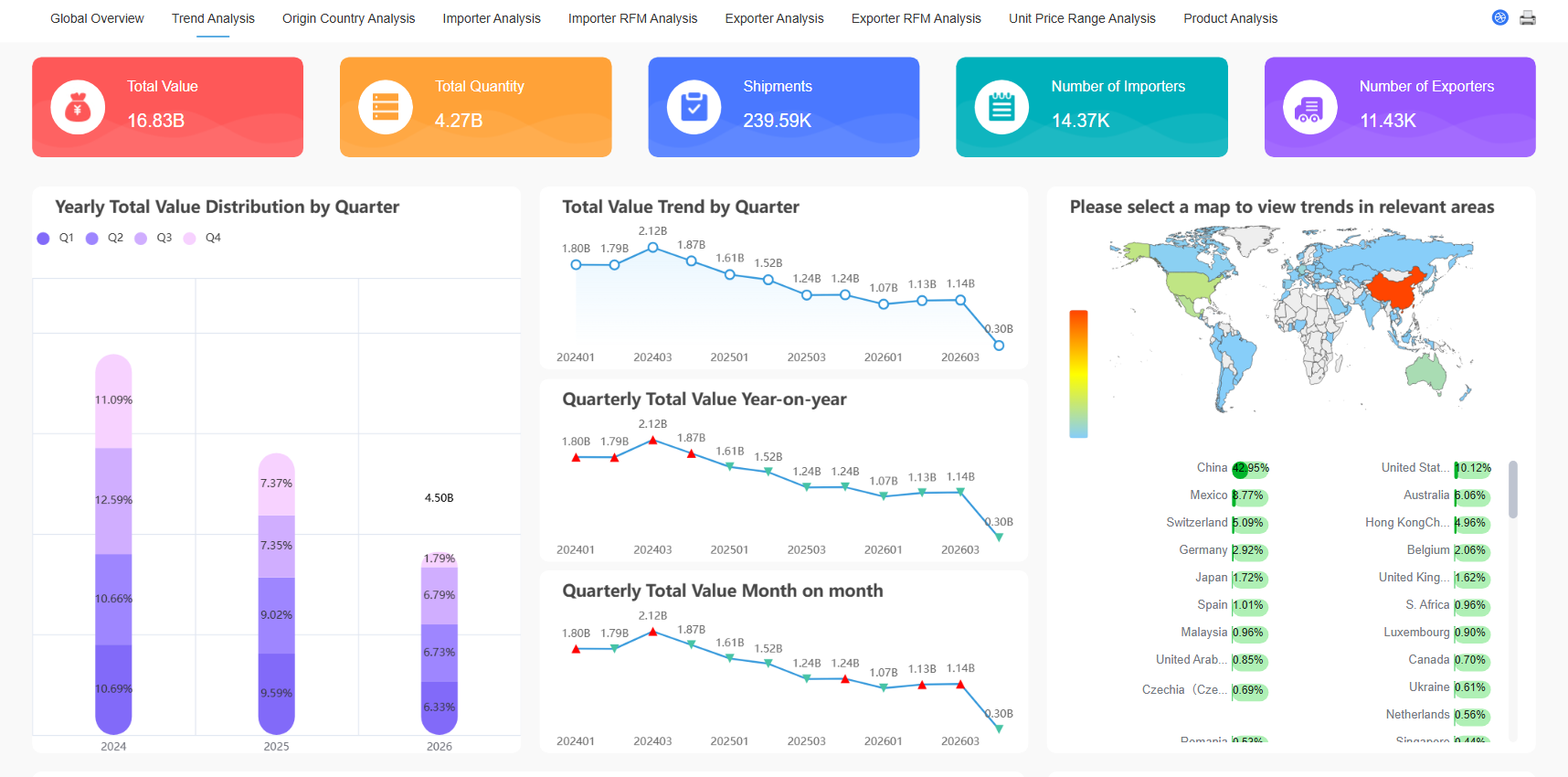
Research import and export activity across markets. Begin with a country, then identify the data type, product coverage and historical period relevant to your decision.
Browse country trade data
87 country & market profiles
 Afghanistan
 Angola
 Argentina
 Armenia
 Australia
 Bangladesh
 Belarus
 Benin
 Bolivia
 Botswana
 Brazil
 Burkina Faso
 Burundi
 Cameroon
 Canada
 Central African Republic
 Chad
 Chile
 Colombia
 Costa Rica
 Côte d’Ivoire
 Democratic Republic of the Congo
 Dominican Republic
 Ecuador
 Egypt
 Ethiopia
 Fiji
 Gabon
 Georgia
 Germany
 Ghana
 Guatemala
 Guyana
 India
 Indonesia
 Iran
 Japan
 Kazakhstan
 Kenya
 Kosovo
 Kyrgyzstan
 Lesotho
 Liberia
 Madagascar
 Malawi
 Malaysia
 Maldives
 Mexico
 Moldova
 Mongolia
 Namibia
 Nicaragua
 Niger
 Nigeria
 Pakistan
 Palestine
 Panama
 Paraguay
 Peru
 Philippines
 Poland
 Russia
 Rwanda
 São Tomé and Príncipe
 Senegal
 Sierra Leone
 Singapore
 South Africa
 South Korea
 South Sudan
 Spain
 Sri Lanka
 Taiwan, China
 Tanzania
 Thailand
 Togo
 Turkey
 Uganda
 Ukraine
 United Kingdom
 United States
 Uruguay
 Uzbekistan
 Venezuela
 Vietnam
 Zambia
 Zimbabwe
No matching market. Try another name or region.
Markers indicate data profiles, not office locations. Customs, shipment and trader-directory coverage varies by market.
Country profiles introduce the research context. Dataset coverage and available fields differ between markets.
Choose a product, then define its HS classification, market and research period. Each guide explains the fields and source limits to check.
Explore product trade dataComposition, grade and application.
↗Fibres, fabrics and finished goods.
↗Equipment, assemblies and spare parts.
↗Commodity form, origin and period.
↗Components, modules and finished devices.
↗Part function, material and assembly level.
↗Compare target markets and build buyer or supplier shortlists for direct commercial assessment.
Explore trade solutions ↗LOGISTICS & FREIGHTIdentify trading companies that fit your cargo and market focus, then prepare better informed account conversations.
Explore logistics solutions ↗TRADE SERVICESDevelop country, product and company studies for market research, advisory work and trade services.
Explore trade services ↗Available company and transport fields vary by source. Use historical records to guide further research and confirm current requirements directly.
Work with SINOBTD across the full service lifecycle. We engage with customers worldwide and support the transition from an initial requirement to practical product use.
How we work with your teamDefine the business question, markets, products and data requirements.
Explore the product in the context of your research and working practices.
Coordinate the agreed product access, data or service delivery.
Help your team understand the product and the workflows relevant to its role.
Provide ongoing assistance with product use and service questions.
Trade data describes recorded imports and exports. Depending on the source, it shows market totals, individual transactions, shipping activity or company profiles.
Compare market totals by product, country and period. Aggregate statistics do not identify individual buyers or suppliers.
Describe declared transactions. Product, party, value and quantity fields vary by country and source.
Describe cargo movements and reported shipping parties. A shipment record does not establish an available freight contract.
List companies for research. A directory entry does not prove a shipment or a current purchasing requirement.
Source scope and fields differ by market. Check the data type before drawing conclusions.
Read the data source guideMatch the source to your product, market and business question.
Discuss your research requirementsStart with the country profiles to review the available source and data perspective. A country may offer trade records, shipment information or a trader directory. Confirm the product, trade direction, historical period and required fields for your study; a country profile alone does not establish complete coverage.
Explore country data sourcesWhere a selected source reports companies, trade records can help identify parties associated with a product and investigate their reported activity. Check the product description and company role before building a shortlist. A historical record does not prove current buying intent, manufacturing capability or supplier suitability.
Buyer and supplier researchDepending on the source, fields may include dates, HS codes, product descriptions, trading parties, countries, quantities, weights, values or transport details. No single field set applies to every market. Review a matched record for your product and question rather than assuming one example represents the whole database.
Inspect real record examplesDefine the product, material, form and intended research scope. Use the HS code together with the reported description, and check the relevant national subdivision. Then specify the market, trade direction and period. A broad code match can include records that do not fit your exact product.
Plan product-specific researchLogistics teams can research trading companies, products and recorded trade corridors relevant to their services. Where transport or port fields are available, these can help assess account fit. Confirm cargo requirements and commercial interest directly; shipment values do not establish freight spend or an open forwarding opportunity.
Trade data for logistics teamsCompare a matched record with your required product detail, party roles, units, country, direction and period. The public chemical examples use HS 320611 and demonstrate source differences; they do not confirm coverage for other products. Discuss your own requirements with SINOBTD before choosing a dataset.
Review the sample and its limitsExplore recent trade insights and product research, or browse the archive by category.
HS 7108135000 · Jan–Jul 2026Monthly values, leading destinations and export concentration.
Read insight Port image · illustrative
Mid-November booking reviewOrigin dates and destination scope to check before confirming a freight quote.
Read insightLate-November cost reviewReview the surcharge alongside the full shipping cost and booking terms.
Read insightTell us your target country, product or HS code, and the business question you want to answer.